Skip to content

Asphalt Calculator

Use this free asphalt calculator to run an accurate asphalt calculation for hot mix asphalt, blacktop, and asphalt pavement projects. Enter your area in square feet (or length and width), compacted thickness, and density to calculate tons, cubic yards, and estimated cost for driveways, parking lots, roads, and walkways - before you order material from the plant.

Asphalt Calculator Inputs

Enter dimensions and material details.

ft
ft
in

Enter compacted thickness in inches.

lb/ft³

Default 145 lbs/ft³ for compacted hot-mix asphalt.

USD

Calculation Results

Quantities update from the inputs on the left.

Total Tons Needed
Estimated Cost
Estimated Cubic Yards

Estimate only - consult a paving contractor for exact quotes.

How Much Asphalt Do I Need?

The amount of asphalt you need comes down to three numbers: the paved area, the compacted thickness, and the asphalt density. Most hot mix asphalt weighs around 145 lb/ft³, which lets this asphalt calculator convert your measurements - square feet, cubic feet, and depth - into tons of asphalt, cubic yards, and material cost in one step.

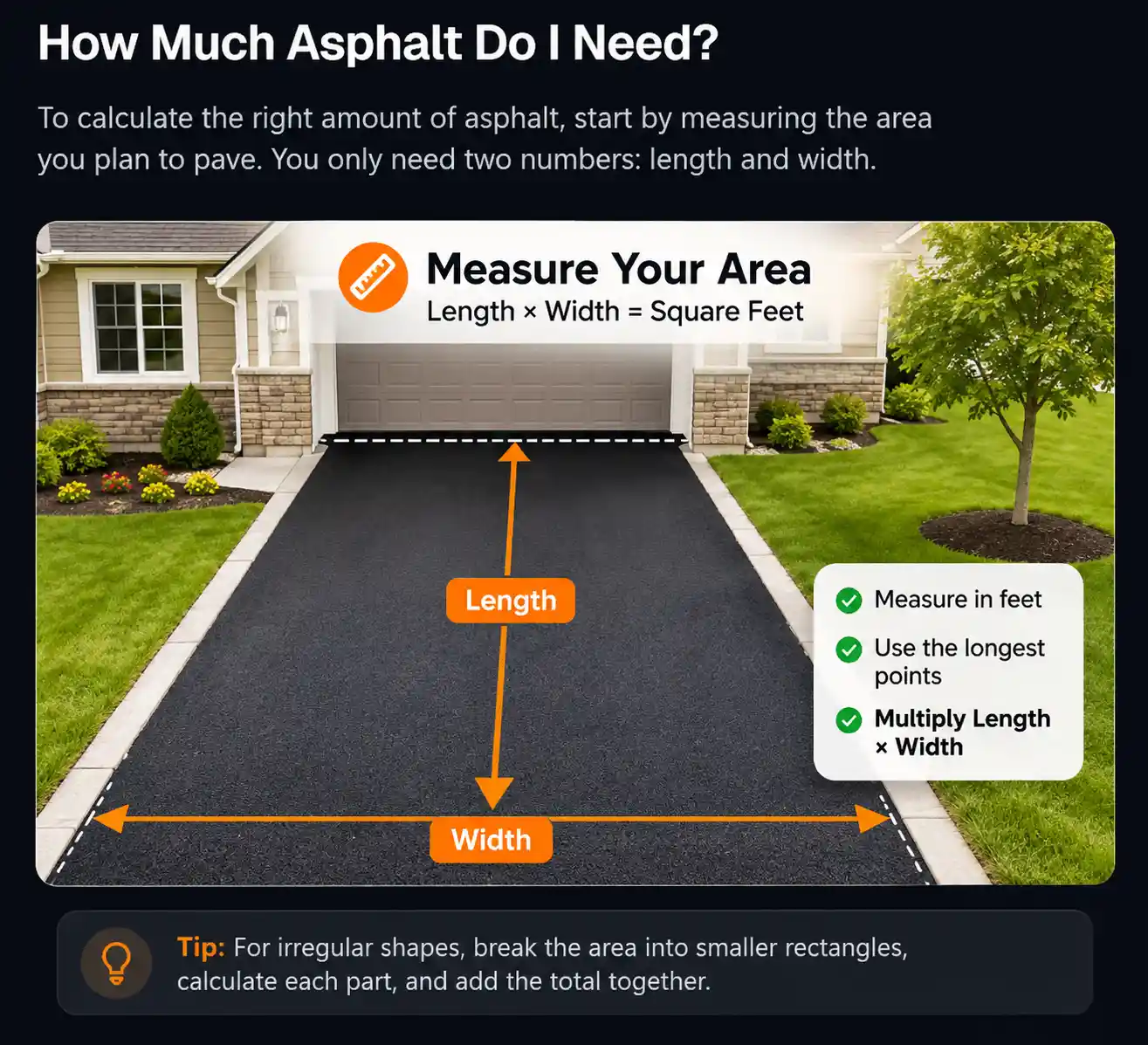
Driveway measurement diagram showing length and width for asphalt calculation.

For uneven areas, split the surface into smaller rectangles and add the total area.

Estimate by Square Feet

Start by measuring the total square footage - multiply length by width in feet. For irregular layouts, split the area into smaller rectangles and add the square footage together before running your asphalt calculation.

Estimate by Driveway Size

Residential driveway asphalt commonly uses 2-3 inches of compacted thickness. Enter your driveway's length and width to estimate how many tons of asphalt and cubic yards of material the project requires.

Estimate by Parking Lot Size

Commercial parking lot asphalt typically needs greater coverage and thickness depending on expected traffic loads. The calculator scales the same tonnage formula from small residential jobs to larger commercial paving projects.

How to Calculate Asphalt for Your Project

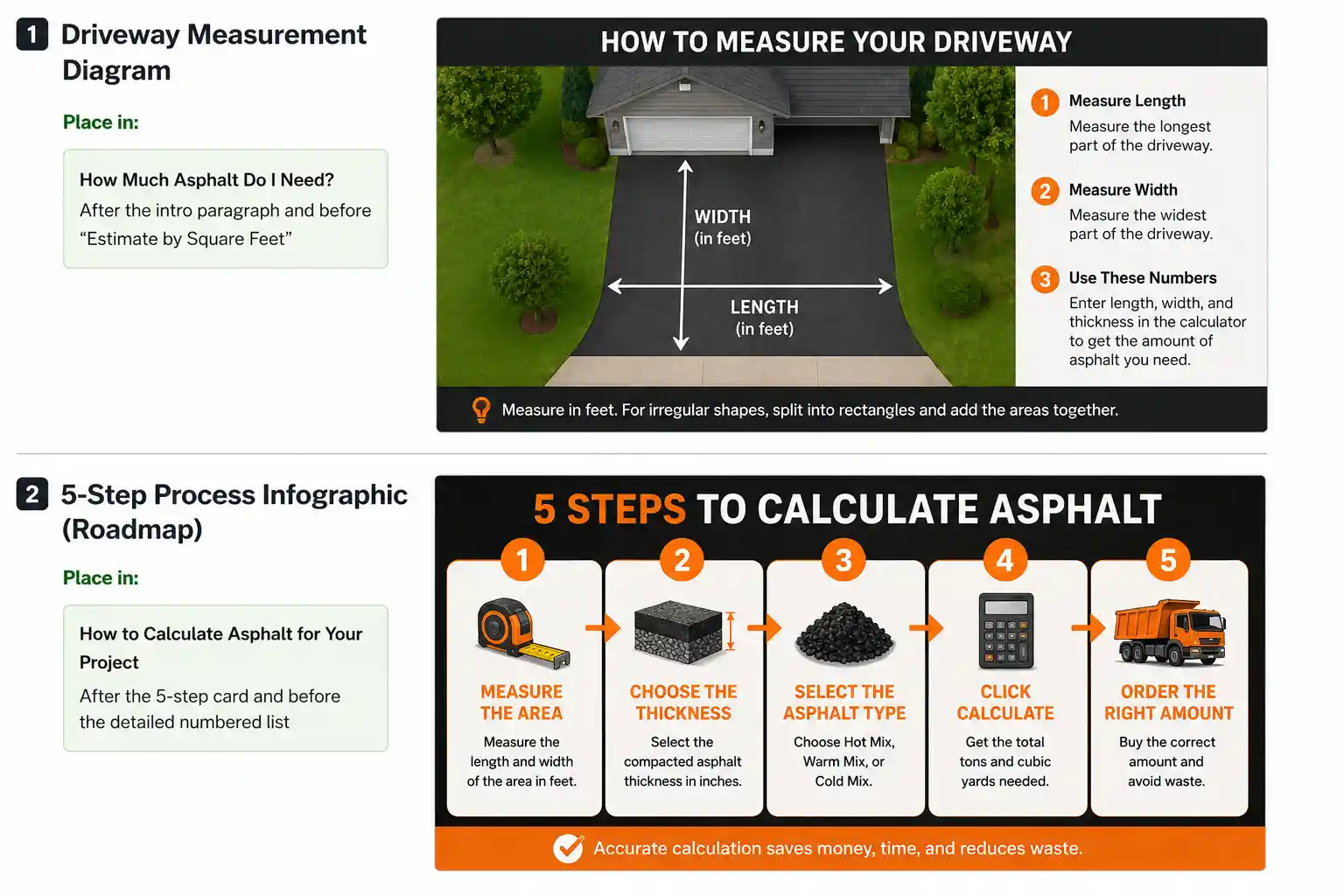
You only need a few numbers to estimate how much asphalt your project needs. Measure the area, choose the thickness, and let the calculator do the math.

5 Simple Steps to Calculate Asphalt

Follow these five simple steps to estimate the right amount of asphalt for your project.

1

Measure the area

Measure the length and width.

2

Choose the thickness

Pick how thick the asphalt will be.

3

Select the asphalt type

Choose Hot Mix, Warm Mix, or Cold Mix.

4

Click Calculate

Get the total tons and cubic yards.

5

Order the right amount

Buy the correct amount and avoid waste.

Five-step asphalt calculation infographic showing measurement, thickness, asphalt type, calculation, and ordering.

Here's how the calculator works behind the scenes.

  1. Measure the area. Measure the length and width in feet. If the shape is uneven, split it into smaller rectangles and add the areas together.
  2. Enter the thickness. Most driveways use 2-3 inches of compacted asphalt, while heavier traffic areas often need more.
  3. Apply asphalt density. The calculator uses a standard hot mix asphalt density of about 145 lb/ft³ unless you enter a different value.
  4. Convert the result to tons. The total weight is divided by 2,000 pounds to give the number of tons you'll need to order.

For the best results, add a small waste factor for edges, uneven surfaces, and compaction, then confirm the final quantity with your paving contractor before ordering material.

Asphalt Calculator Formula

The calculator converts asphalt volume into weight and then into US short tons. Length and width are measured in feet, while thickness is entered in inches.

Example: A 20 ft × 10 ft driveway with a 3-inch compacted thickness and a density of 145 lb/ft³.

  • Volume = 20 × 10 × (3 ÷ 12) = 50 ft³
  • Tons = 50 × 145 ÷ 2000 = 3.63 tons
  • Cubic yards = 50 ÷ 27 = 1.85 yd³

Multiply the area by the compacted thickness, apply asphalt density, and divide by 2,000 to estimate the tons of asphalt needed. This is the standard method used for driveway, parking lot, and road paving estimates.

Asphalt Weight Chart

This asphalt weight chart gives quick reference values for asphalt weight and asphalt coverage per ton at common compacted paving thicknesses, using the standard hot mix asphalt density of 145 lb/ft³.

Compacted ThicknessApprox. WeightCoverage per Ton
2 inches24.2 lb/ft²165 ft²
3 inches36.3 lb/ft²110 ft²
4 inches48.3 lb/ft²83 ft²
5 inches60.4 lb/ft²66 ft²

Asphalt Coverage by Thickness and Tons

Use this quick-reference asphalt coverage chart to estimate how many square feet different tonnage amounts cover at common compacted paving thicknesses. Values assume standard hot mix asphalt with an approximate density of 145 lb/ft³.

Compacted Thickness1 Ton2 Tons5 Tons10 Tons
1 in160 ft²320 ft²800 ft²1,600 ft²
1.5 in107 ft²214 ft²535 ft²1,070 ft²
2 in80 ft²160 ft²400 ft²800 ft²
2.5 in64 ft²128 ft²320 ft²640 ft²
3 in53 ft²106 ft²265 ft²530 ft²
3.5 in46 ft²92 ft²230 ft²460 ft²
4 in40 ft²80 ft²200 ft²400 ft²
5 in32 ft²64 ft²160 ft²320 ft²
6 in27 ft²54 ft²135 ft²270 ft²

Actual asphalt weight can vary slightly by mix design, aggregate type, and compaction. Use these figures as a planning reference before ordering material from a local asphalt plant.

Asphalt Density Explained

Asphalt density determines how much a given volume of material weighs, which directly affects tonnage calculations. Most hot mix asphalt uses an average compacted density of 145 lb/ft³, a widely accepted industry planning value recognized by the National Asphalt Pavement Association (NAPA), making it a reliable reference for driveways, parking lots, and road paving.

Hot Mix Asphalt

Hot mix asphalt is the standard material used for most paving projects. It's produced at high temperatures at the asphalt plant, combining aggregate with asphalt binder, and typically uses the 145 lb/ft³ density assumed by this asphalt calculator.

Warm Mix Asphalt

Warm mix asphalt is manufactured at lower temperatures to reduce energy consumption and emissions. Its density is usually close enough to hot mix asphalt that the same planning estimate is often appropriate.

Cold Mix Asphalt

Cold mix asphalt is commonly used for temporary repairs and patching. Because its composition differs from hot mix, actual density may vary depending on the product and application.

Why Density Matters

Even small density differences can change the number of tons required for a project. Using the correct value helps reduce waste, avoid additional deliveries, and produce more accurate asphalt estimates.

Asphalt Cost Per Ton

Hot mix asphalt commonly ranges around $100-$200 per ton for material alone, although labor, haul distance, mix type, and seasonal demand can affect the final installed price. These figures reflect typical U.S. market averages, and you can compare them with Angi's asphalt driveway cost data for real project benchmarks.

For a full asphalt cost estimate - including installed pricing - use our Asphalt Cost Calculator.

Asphalt Driveway Cost Examples

These examples show how driveway size, paving thickness, and price per ton affect the final estimate. They assume a 3-inch compacted hot mix asphalt layer with a density of 145 lb/ft³.

10×20 Driveway (200 ft²)

A 200-square-foot driveway at 3 inches typically requires about 3.6 tons of asphalt. At $150 per ton, the estimated material cost is about $545.

20×20 Driveway (400 ft²)

A 400-square-foot driveway usually requires about 7.3 tons of asphalt. At $150 per ton, the estimated material cost is roughly $1,090.

Large Residential Driveway (600 ft²)

A larger 600-square-foot driveway typically needs around 10.9 tons of hot mix asphalt. At $150 per ton, the estimated material cost is approximately $1,635.

These examples are planning estimates only. Waste allowance, edging, compaction, and local pricing can change the final amount of asphalt required for a driveway project.

Recommended Asphalt Thickness

Recommended asphalt thickness varies by project: most residential driveways use 2-3 inches of compacted asphalt, while parking lots, private roads, and heavier traffic typically require greater structural depth.

Asphalt Thickness Guide by Project Type

Use this quick-reference guide to choose the right compacted asphalt thickness for common residential and commercial projects.

Project TypeRecommended ThicknessTypical Use
Walkway1.5-2 inFoot traffic
Patio2 inResidential
Bicycle Path2 inLight traffic
Residential Driveway2-3 inCars and SUVs
Heavy Residential Driveway3-4 inRVs and pickups
Commercial Parking Lot3-5 inRegular vehicle traffic
Loading Area5-8 inHeavy trucks
Private Road3-6 inMixed traffic
Farm Road3-5 inEquipment traffic
Industrial Yard6-10 inHeavy equipment

These are general recommendations. Local climate, soil conditions, and expected traffic may require a thicker pavement structure.

See exact compacted thickness by project type in our Asphalt Thickness Calculator.

Cubic Yards vs Tons

Converting cubic feet and cubic yards into tons depends on asphalt density - this calculator performs that conversion automatically using your dimensions and density value.

For a dedicated cubic-yards-to-tons breakdown, use our Asphalt Volume Calculator

Common Asphalt Project Examples

The same asphalt calculation method works across residential and commercial paving projects. The only variables that change are surface area, compacted thickness, and expected traffic load.

Residential Driveway

Most residential driveways use 2-3 inches of compacted hot mix asphalt. Measuring the full paved area before ordering helps avoid unnecessary waste and additional deliveries.

Commercial Parking Lot

Parking lots typically require greater material quantities because of their larger surface area and heavier traffic. Larger commercial jobs often benefit from more accurate tonnage planning before scheduling paving crews.

Walkway

Walkway asphalt projects usually require less material than driveways, but accurate width and length measurements still improve ordering accuracy and reduce leftover mix.

Private Road

Private road asphalt often requires thicker sections depending on vehicle loads and subgrade conditions. Calculating the total area first gives a reliable starting point for estimating tons and cost.

Whether you're paving a driveway, parking lot, walkway, or private road, entering accurate dimensions into the asphalt calculator produces a more reliable material estimate before requesting contractor quotes.

Blacktop vs Asphalt

Blacktop and asphalt are often used interchangeably, but the terms are not always identical. In everyday conversation, blacktop usually refers to asphalt pavement used for driveways and roads, while asphalt is the broader material made from aggregates and asphalt binder.

What's the Difference?

So what is asphalt, exactly? It's an engineered paving material made from stone, sand, and asphalt binder. What is blacktop, then? It's mostly a consumer term for that same asphalt pavement, especially on residential driveways - though many contractors use both words interchangeably.

Which Term Should You Use?

If you're requesting quotes from paving contractors, either term is generally understood. "Asphalt" is the more precise technical term, while "blacktop" is the everyday name many homeowners use for the same type of paved surface.

This asphalt calculator works for both blacktop and asphalt pavement projects because the underlying material calculations-area, thickness, density, and tonnage-remain the same.

What Is Asphalt?

Asphalt is a paving material made by combining crushed stone, sand, and gravel with asphalt binder, a petroleum-based material that holds the aggregate together. It creates a smooth, durable surface for roads, driveways, parking lots, and walking paths.

Most paving projects use hot mix asphalt, which is produced at high temperatures and compacted after placement. Modern asphalt is also one of the most recycled construction materials, allowing old pavement to be reused in new asphalt mixes.

Why Choose Asphalt?

Asphalt remains one of the most popular paving materials because it balances durability, cost, and ease of installation for both residential and commercial projects.

  • Fast installation: Many residential driveways can be paved in a single day.
  • Cost-effective: Asphalt is often more affordable than concrete.
  • Easy repairs: Small cracks and damaged sections can usually be patched without replacing the entire surface.
  • Flexible performance: Asphalt handles seasonal temperature changes better than many rigid paving materials.
  • Recyclable: Existing pavement can often be reused in future paving projects.

Common Asphalt Uses

Home Projects

  • Driveways
  • Walkways
  • Patios
  • Private roads

Commercial Projects

  • Parking lots
  • Loading zones
  • Business entrances
  • Access roads

Public Infrastructure

  • Highways
  • City streets
  • Airport pavements
  • Bicycle paths

Common Mistakes When Estimating Asphalt

Small measurement errors can change an asphalt order by several hundred pounds or even multiple tons. Avoiding these common mistakes helps produce a more accurate estimate before ordering hot mix asphalt.

Using the Wrong Thickness

Enter compacted asphalt thickness rather than loose material thickness. Choosing the wrong depth can significantly change the number of tons required for a driveway, parking lot, or road.

Ignoring Waste and Edges

Most paving projects benefit from a small waste allowance for joints, trimming, and truck variation. Ordering the exact calculated amount may leave too little material to finish the job.

Using the Wrong Density

Hot mix asphalt is commonly estimated at 145 lb/ft³, but some mix designs differ slightly. Using the correct density produces a more reliable tonnage estimate.

Measuring Irregular Areas Incorrectly

Curved driveways, islands, and parking lot medians should be divided into smaller sections before calculating total square footage. This method reduces measurement errors on complex layouts.

Measuring carefully, using the correct asphalt thickness, and accounting for density and waste will produce a more dependable material estimate before requesting contractor quotes.

Taking Care of Your Asphalt Surface

Proper maintenance helps asphalt last longer and reduces repair costs. Small cracks are much easier to fix before they become larger problems.

  • Keep the surface clean by removing dirt and debris.
  • Repair cracks before water reaches the base layer.
  • Sealcoat when appropriate for your climate and traffic conditions.
  • Prevent standing water whenever possible.
  • Avoid heavy loads until new asphalt has fully cured.

Waste Factor Explained

Most asphalt estimates include a small waste allowance because the exact amount delivered rarely matches the finished paved area perfectly.

  • Irregular edges that require extra material.
  • Compaction during paving reduces loose material volume.
  • Small losses during transport and placement.
  • Hand finishing around borders and joints.
  • Minor truck load variation.

For most residential projects, planning for about 5-10% additional material provides a practical safety margin.

Final Planning Tips

  • Measure the paved area carefully before ordering material.
  • Choose the correct compacted thickness for your project type.
  • Use realistic density and waste assumptions.
  • Confirm supplier pricing by the ton before delivery.
  • Double-check your estimate before scheduling the paving crew.

This calculator is intended for planning estimates. Actual material requirements may vary depending on local specifications, compaction, and site conditions.

Frequently Asked Questions

How do you calculate asphalt tonnage?

Measure the length and width in feet, convert the compacted depth from inches to feet, multiply by asphalt density, then divide by 2,000 to convert pounds into US short tons.

How much asphalt do I need?

The amount of asphalt depends on your project's length, width, thickness, and density. Enter those measurements into the calculator to estimate tons, cubic yards, and material cost.

How do you measure asphalt?

Measure the paved area's length and width in feet, break irregular shapes into smaller rectangles, add the total square footage, and use the compacted thickness for the calculation.

How much does a ton of asphalt cover?

Coverage depends on paving thickness. One ton typically covers about 165 square feet at 2 inches, around 110 square feet at 3 inches, and about 83 square feet at 4 inches.

How much asphalt is needed for a driveway?

Most residential driveways use 2–3 inches of compacted hot mix asphalt. Enter your driveway dimensions into the calculator to estimate the required tonnage and material cost.

How much does an asphalt driveway cost?

Driveway cost depends on square footage, asphalt thickness, local price per ton, labor, and site preparation. Material prices alone commonly range around $100–$200 per ton.

How much does asphalt cost per ton?

Hot mix asphalt commonly ranges from about $100–$200 per ton for material alone, although regional pricing, haul distance, season, and mix type can change the final cost.

How much does asphalt cost per square foot?

Cost per square foot depends on paving thickness, material price, labor, and site conditions. The calculator estimates cost by converting your measurements into the required tonnage.

How many cubic yards are in a ton of asphalt?

Using a typical compacted density of 145 lb/ft³, one ton of asphalt is approximately 0.51 cubic yards, although actual values vary slightly by mix design.

How much does a cubic yard of asphalt weigh?

A cubic yard of compacted hot mix asphalt typically weighs about 3,900 pounds, or roughly 1.95 tons, depending on the mix density.

How much does asphalt weigh?

Compacted hot mix asphalt commonly weighs about 145 pounds per cubic foot, which equals roughly 24 pounds per square foot at 2 inches of thickness.

What is asphalt made of?

Asphalt is made from crushed stone, sand, mineral filler, and asphalt binder, which are mixed together to create a durable paving material for roads, driveways, and parking lots.

What is the difference between blacktop and asphalt?

Blacktop is a common name for asphalt pavement used on driveways and roads, while asphalt is the broader engineered paving material made from aggregates and asphalt binder.

What is asphalt used for?

Asphalt is commonly used for driveways, parking lots, roads, walkways, overlays, and other residential and commercial paving projects because it is durable and cost-effective.

How much weight can asphalt hold?

The weight asphalt can support depends on its thickness, base preparation, and traffic load. Residential driveways usually handle passenger vehicles, while heavier traffic requires thicker pavement and stronger base construction.
Explore Our Other Calculators

  • Asphalt Tonnage Calculator

    Convert paved area and depth into tons of mix.

  • Asphalt Driveway Calculator

    Size a residential driveway and estimate coverage.

  • Asphalt Cost Calculator

    Budget material cost from tons and unit price.

ℹ️

Planning estimate notice

Asphalt Calculator provides free estimation tools for planning purposes only. Results are not a substitute for a professional quote or engineering advice. Actual material and cost requirements can vary by site conditions, mix design, and region. Always confirm final quantities and pricing with a licensed paving contractor before ordering material. See our Disclaimer for full details.